
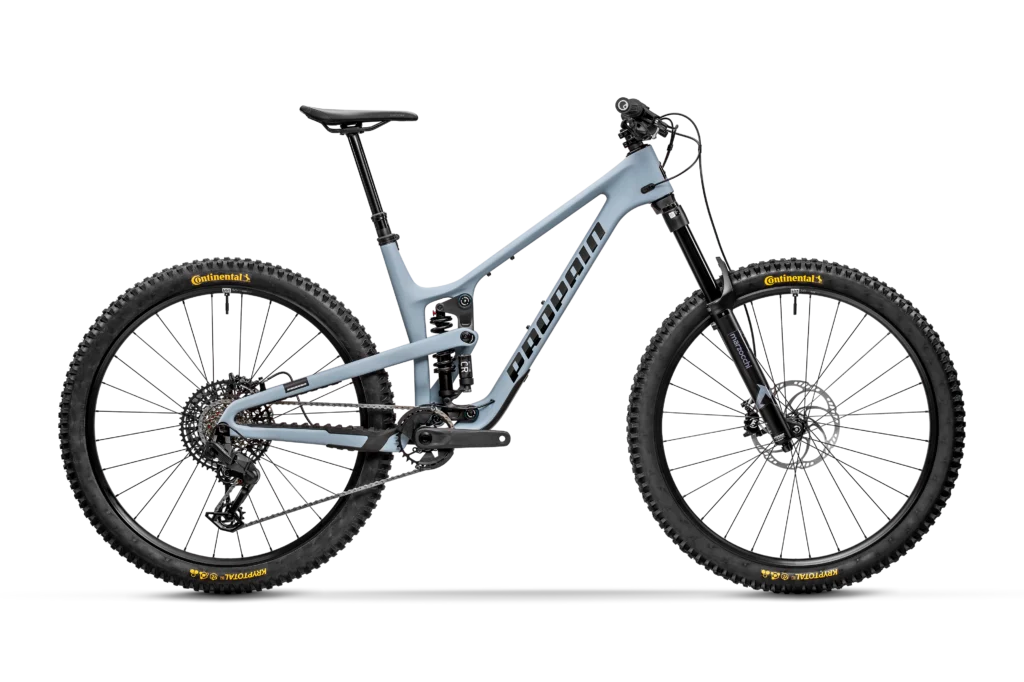
Suspension travel is the amount a bike’s fork and rear shock can compress. More travel soaks up bigger hits and keeps you composed at speed. Less travel makes a bike lighter, quicker and more efficient to pedal. Picking the right amount comes down to the trails you ride most.
Travel by riding style
| Category | Typical rear travel | Best for |
|---|---|---|
| Trail | 130 to 150 mm | All-round riding, climbs and descents |
| Enduro / all-mountain | 150 to 170 mm | Steep, rough descents you still pedal up |
| Freeride / bike park | 170 to 190 mm | Jumps, drops and lift-served laps |
| Downhill | 190 mm and up | Racing and bike park, not built for climbing |
Trail: 130 to 150 mm
The do-it-all category. A trail bike climbs efficiently and still has enough travel for roots, rocks and small drops. Many e-MTBs live here, such as the Orbea Rise SL M10 with a 140 mm build, and the Specialized Turbo Levo 4 Expert with 150 mm rear and a 160 mm fork.
Enduro: 150 to 170 mm
Built for riders who want to descend fast on steep, technical terrain but still pedal back up. The Propain Tyee CF pairs 160 mm of PRO10 rear travel with a 170 mm fork, and the Pivot Shuttle LT Pro brings 162 mm rear and 170 mm front to the e-MTB world. See all enduro mountain bikes.
Freeride: 170 to 190 mm
For bike parks, big lines and jumps. The Propain Spindrift CF runs 180 mm of rear travel with a 180 mm fork, and a flip chip lets you run 29″ or mixed wheels.
Downhill: 200 mm and up
Pure gravity machines. The Santa Cruz V10 DH S has 208 mm of VPP rear travel and a RockShox BoXXer fork, and the V10 DH X01 steps up to FOX 40 Factory suspension. These are bike park and race bikes, not trail bikes. Browse downhill mountain bikes.
How to choose
- Be honest about where you ride most. Pick travel for your regular trails, not the one trip a year to a bike park.
- More travel is not always faster. On smooth or rolling trails, a shorter-travel bike is quicker and more fun.
- On an e-MTB, you can go a little longer. The motor offsets the extra weight on climbs, which is why many e-MTBs run 150 to 160 mm.
- Check fork travel too. Most modern bikes run 10 to 20 mm more travel up front than in the rear.
Choosing an e-MTB? Read full-power vs lightweight e-MTB next.
Frequently asked questions
Is 150 mm of travel enough?
For most riders, yes. 150 mm handles the majority of trail and light enduro terrain while staying efficient on climbs.
Can I climb on a downhill bike?
Not comfortably. Downhill bikes are built for descending and are usually ridden with lifts or shuttles.
Not sure which bike fits your riding? Email support@cyclevanta.shop.