
Battery capacity, measured in watt-hours (Wh), decides how far an e-MTB can take you on a charge. But bigger is not automatically better: a larger battery adds weight, and the motor, terrain, rider weight and assist mode all affect real-world range. Here is how to pick the right size.
Battery sizes on today’s e-MTBs
| Battery size | Typical bike type | Examples we stock |
|---|---|---|
| 400 to 420 Wh | Lightweight e-MTB | Pivot Shuttle SL/AM (400 Wh), Orbea Rise SL (420 Wh) |
| 600 Wh | Light full-power | Cannondale Moterra SL (601 Wh), Propain Ekano (600 Wh option) |
| 800 to 840 Wh | Full-power | Pivot Shuttle AM, LT and AMP’d (800 Wh), Specialized Turbo Levo 4 (840 Wh) |
What affects real-world range
- Assist mode: riding in the highest mode can drain a battery several times faster than an eco mode.
- Climbing: elevation gain uses far more energy than distance on flat ground.
- Rider and gear weight: heavier loads mean more work for the motor.
- Motor power: high-torque motors deliver more help, and use more energy to do it.
- Temperature: lithium batteries give less range in the cold.
Which size is right for you?
400 to 420 Wh: lightweight and nimble
Ideal if you like to pedal and ride for two to three hours at a time. Bikes like the Pivot Shuttle SL/AM and Orbea Rise SL accept range extenders (250 Wh and 210 Wh respectively), so you can add capacity only when you need it.
600 Wh: the middle ground
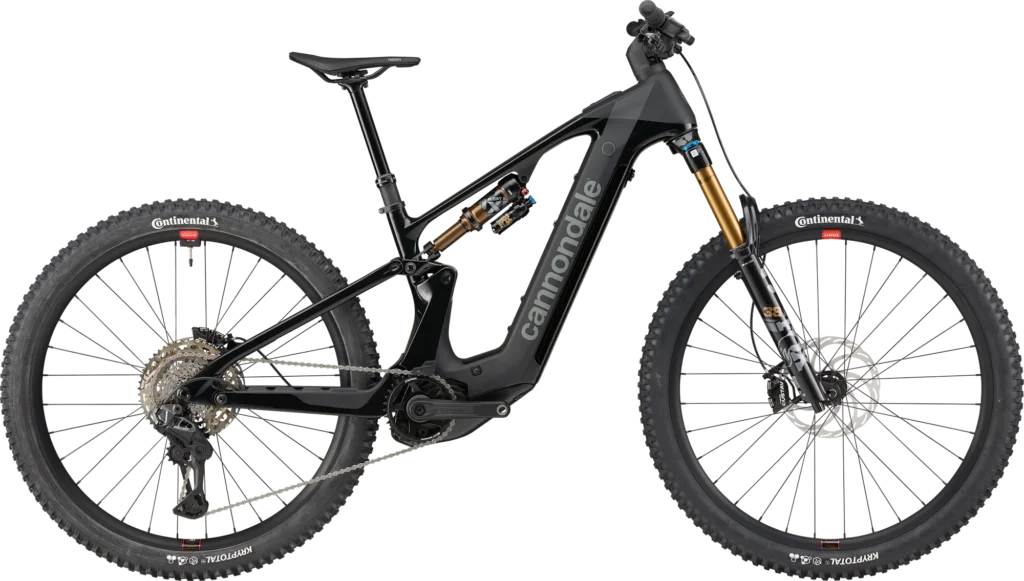
A good balance of weight and range. The Cannondale Moterra SL 2 pairs a 601 Wh battery with a Shimano EP801 motor.
800 Wh and up: big days and big climbs
For long rides, lots of elevation or riders who want maximum assistance. The Specialized Turbo Levo 4 Expert (840 Wh) and the Pivot Shuttle AM (800 Wh) are built for this. The Pivot Shuttle AMP’d adds 12 A fast charging, reaching 80 percent in about 90 minutes.
Tips to get more range
- Use a lower assist mode on flat and rolling sections.
- Shift gears to keep a steady, comfortable cadence.
- Keep tires at the right pressure.
- Store and charge the battery at room temperature.
- Carry a range extender on big days, if your bike supports one.
Not sure whether you need a full-power or lightweight bike? Read full-power vs lightweight e-MTB.
Frequently asked questions
How far can an 800 Wh e-MTB go?
It depends heavily on terrain, mode and rider weight. On mixed trails in a medium mode, an 800 Wh battery typically covers a long day of riding. Steep climbing in the top mode shortens that considerably.
Is a range extender worth it?
On a lightweight e-MTB, yes, if you sometimes ride longer than usual. You carry the extra weight only when you need it.
Questions? Email support@cyclevanta.shop or browse all electric mountain bikes.