Every e-MTB on the market now falls into one of two camps. Full-power bikes use big motors and big batteries to flatten climbs and pile on laps. Lightweight (or “SL”) bikes use smaller motors and batteries to stay closer to the feel of a regular mountain bike. Both are great. The right one depends on how and where you ride.
The short answer
- Choose full-power if you want the most assistance, ride long or steep climbs, want to fit more laps into a ride, or are heavier or carry a pack.
- Choose lightweight if you want a bike that handles like an analog trail bike, enjoy putting in effort yourself, or need to lift the bike onto racks and over obstacles.
What separates the two
| Full-power e-MTB | Lightweight e-MTB | |
|---|---|---|
| Typical motor torque | 85 to 150 Nm | 50 to 60 Nm (some up to 85 Nm) |
| Typical battery | 600 to 840 Wh | 350 to 430 Wh, often with a range extender |
| Ride feel | Strong push, fast climbing | Natural, playful, more like a regular bike |
| Best for | Big days, steep climbs, maximum laps | Trail riding, mixed terrain, riders who like to work |
Full-power e-MTBs we stock
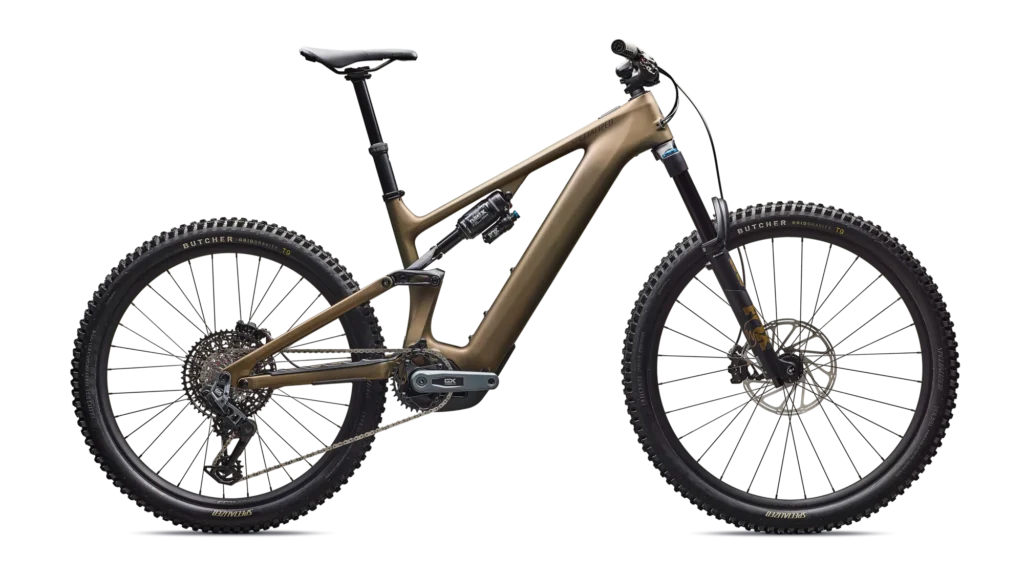
- Specialized Turbo Levo 4 Expert: Specialized 3.1 motor with 101 Nm and 666 W peak, 840 Wh battery, 160 mm fork and 150 mm rear travel.
- Pivot Shuttle AMP’d Pro X0: DJI Avinox M2S motor with up to 150 Nm of torque and 1,300 W peak, 800 Wh battery with fast charging.
- Cannondale Moterra 1: Bosch Performance Line CX motor, 800 Wh removable battery, FOX Factory 38 fork.
- Propain Ekano AL Trail: DJI Avinox drive with up to 150 Nm and an 800 Wh battery in a 160/150 mm aluminum chassis.
Lightweight e-MTBs we stock
- Santa Cruz Heckler SL GX AXS: Fazua Ride 60 motor (60 Nm), 160 mm fork, 150 mm VPP rear travel, carbon frame.
- Orbea Rise SL M10: Shimano EP801 RS Gen 2 motor tuned for a lighter bike, 420 Wh battery with a 210 Wh range extender option, Shimano XT Di2.
- Pivot Shuttle SL/AM Pro X0: Bosch Performance SX motor with 600 W peak, 400 Wh battery expandable with a 250 Wh range extender.
- Propain Sresh SL: TQ HPR60 motor (60 Nm, 350 W), a quiet and natural-feeling option with 160/150 mm travel.
How to decide
Think about your climbs
If your local climbs are long, steep or technical, a full-power motor makes them easy and leaves energy for the descent. If your trails roll up and down, a lightweight bike is often more fun and feels more connected.
Think about range
A bigger battery means more laps, but a lightweight bike uses less energy to move its own weight. Many SL bikes accept a range extender, so you can carry extra capacity only on big days. Read our e-MTB battery size guide for more.
Think about handling
Lightweight bikes are easier to throw around, pop off features and lift onto a car rack. Full-power bikes feel more planted at speed and on rough descents.
Think about the motor feel
Motors feel very different from one another, even at similar torque figures. See our e-MTB motor comparison for a brand-by-brand breakdown.
Frequently asked questions
Is a lightweight e-MTB good for beginners?
Yes, as long as you are happy to pedal. It gives you a boost on climbs while still feeling like a regular mountain bike. Riders who want the most help on climbs usually prefer full-power.
Can a lightweight e-MTB handle enduro trails?
Many can. Bikes like the Heckler SL and Sresh SL run 160 mm forks and 150 mm rear travel, which is plenty for most enduro-style trails.
Which is easier to transport?
Lightweight e-MTBs, because they weigh less and are easier to lift onto racks.
Questions about sizing or specs? Email support@cyclevanta.shop. Browse every model in our electric mountain bike collection.